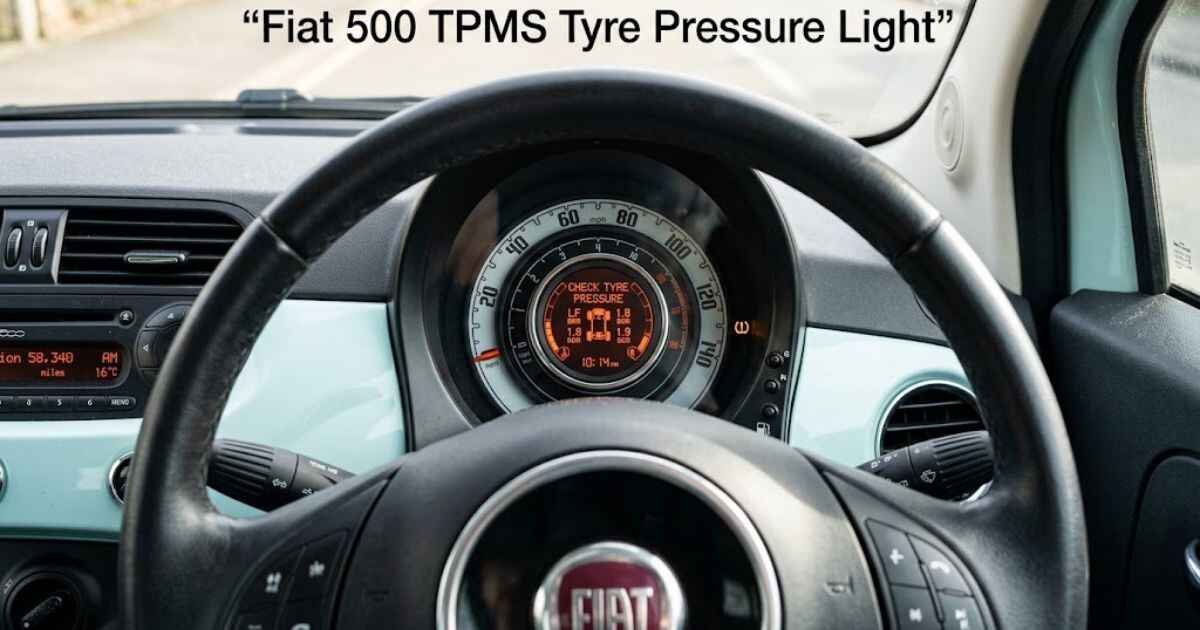
If your Fiat 500 TPMS tyre pressure light has appeared, the first thing to do is check the tyre pressures rather than immediately assuming the TPMS sensor has failed. A steady warning can mean one or more tyres are below the recommended pressure or that the system has detected a slow loss of pressure. On some Fiat 500 versions, the TPMS can also report a system fault separately.
Can you drive with the Fiat 500 tyre pressure light on? Only if the tyres have been checked and are safe. If a tyre is visibly flat, losing pressure quickly, or the car feels unstable, stop driving and deal with the tyre first. Fiat specifically warns that driving on a flat or significantly underinflated tyre can compromise handling and may lead to tyre failure.
See our complete Fiat 500 Warning Lights guide
Fiat 500 TPMS Tyre Pressure Light: Quick Answer
The Fiat 500 TPMS tyre pressure light normally means the system has detected low tyre pressure or, depending on the version, a problem with the tyre-pressure monitoring system.
Here’s what to do:
- Check all four tyres as soon as possible.
- Inflate them to the pressure specified on your Fiat’s tyre-pressure placard or in the owner’s handbook.
- Look for a nail, screw, puncture, damaged sidewall, or slow leak.
- If your version uses an iTPMS reset procedure, perform the reset after correcting the pressures.
- Drive normally afterward so the system can complete its monitoring or self-learning process.
- If the light flashes and then stays on, or a service message appears, the problem may be with the TPMS itself rather than simply low pressure.
The exact TPMS setup and reset procedure can vary by Fiat 500 model year and market, so your vehicle’s handbook takes priority.
What Does the Fiat 500 TPMS Tyre Pressure Light Mean?
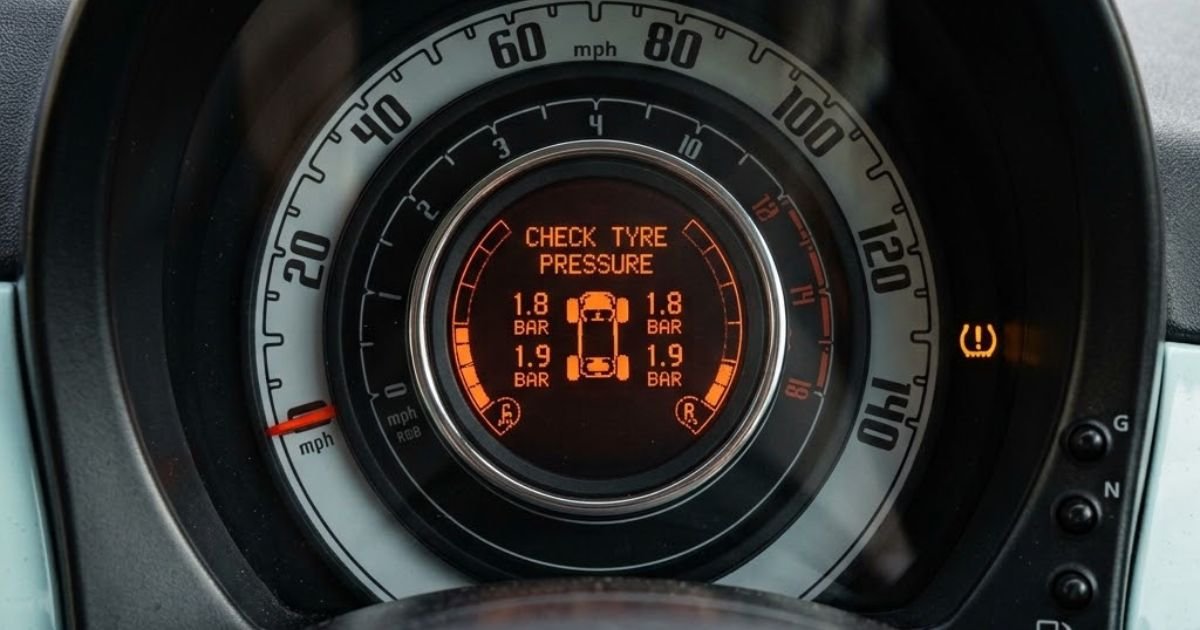
TPMS stands for Tyre Pressure Monitoring System. Its job is to warn you when tyre inflation is outside the expected range.
On the 2019 Fiat 500, the owner’s documentation describes the low-pressure warning as an indication that tyre pressure is below the recommended value or that the vehicle has detected a slow loss of pressure. Fiat says the driver should restore the correct pressure and then follow the applicable tyre-reset procedure.
This is important because the warning does not automatically mean you need a new TPMS sensor.
A simple pressure loss can trigger the warning.
For example, a tyre can gradually lose air because of a small puncture, valve issue, tyre damage, or normal pressure loss. A significant temperature change can also change tyre pressure enough to trigger a warning.
Can You Drive With the Fiat 500 Tyre Pressure Light On?
Yes, but only after checking the tyres and confirming they are properly inflated and safe.
If the light has just appeared and the Fiat feels normal, reduce your speed and check the tyre pressures at the first safe opportunity.
Do not continue driving normally if:
- A tyre looks noticeably low or flat
- The car pulls to one side
- Steering suddenly feels different
- You hear unusual tyre noise
- A tyre is losing pressure rapidly
- The tyre has visible damage
- You suspect a puncture
If one or more tyres are flat, Fiat advises stopping the vehicle and avoiding sharp braking or steering because handling can be compromised.
The key rule is simple: the TPMS light itself is not the reason to panic. An unsafe tyre is.
Why Is My Fiat 500 TPMS Light On?
There are several possible causes.
1. Low tyre pressure
This is the first thing to check.
Measure all four tyres when they are cold and compare the readings with the pressure information supplied for your particular Fiat 500.
Do not rely on a generic PSI number found online. The correct pressure can depend on the vehicle version, tyre size, load and market.
2. Slow puncture or air leak
A tyre may lose air slowly without looking obviously flat.
A nail, screw, damaged valve, bead leak or tyre damage can gradually reduce pressure until the TPMS warning appears.
If you inflate the tyre and the warning returns repeatedly, have the tyre inspected instead of repeatedly adding air.
3. Temperature change
Cold weather can reduce tyre pressure. This can make a previously acceptable tyre fall below the system’s warning threshold.
However, temperature should not be used as an excuse to ignore the warning. Check the actual pressure.
4. Tyre recently changed or rotated
Some Fiat 500 versions equipped with iTPMS require a tyre reset after changing tyre pressure, replacing a tyre, rotating the tyres or fitting a space-saver wheel. Fiat documentation says failing to perform the reset in these circumstances can result in false indications.
5. TPMS system fault
If the warning light flashes for around 75 seconds and then remains illuminated, that is different from a straightforward low-pressure warning on the 2019 U.S. Fiat 500.
The owner’s guide associates this pattern with a TPMS system fault and may display a “Service Tire Pressure Monitoring System” message.
That situation calls for diagnosis rather than simply adding air.
What Tyre Pressure Should a Fiat 500 Have?
There isn’t one universal pressure figure that should be used for every Fiat 500.
Use the tyre-pressure placard on your vehicle and the pressure information in your owner’s handbook.
This is better than copying a PSI number from another Fiat 500 because different versions can have different tyre sizes, loads and specifications.
When checking pressure, use a reliable pressure gauge and ideally check the tyres when they are cold.
Do not reduce pressure from a hot tyre simply because the reading is higher. Heat naturally increases tyre pressure.
How to Check Fiat 500 Tyre Pressure
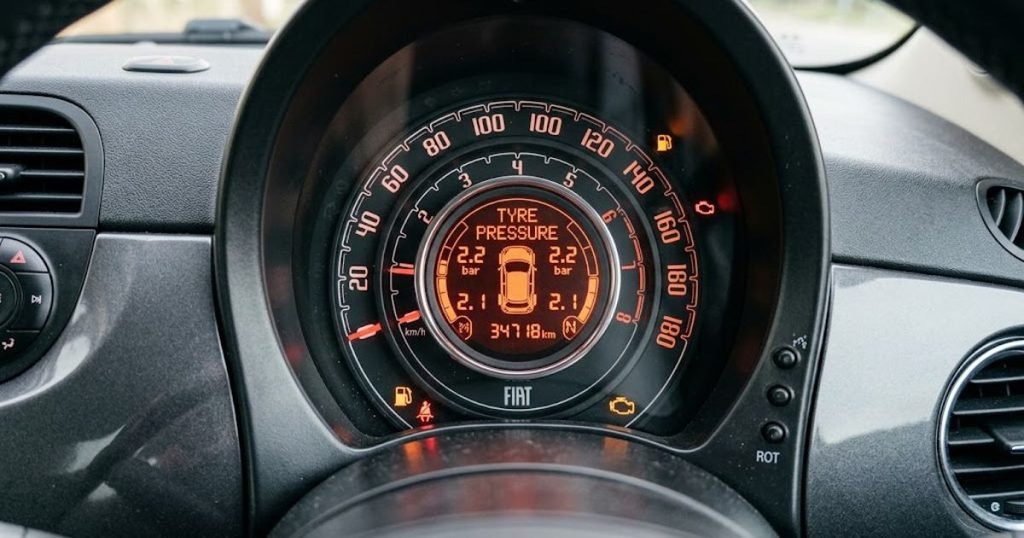
Checking the pressure is straightforward:
- Park the Fiat on a safe, level surface.
- Allow the tyres to cool if possible.
- Remove the valve cap.
- Attach a reliable tyre-pressure gauge.
- Check all four tyres.
- Compare the readings with the vehicle’s recommended cold pressures.
- Inflate any tyre that is low.
- Inspect each tyre for obvious damage or a puncture.
- Replace the valve caps securely.
Don’t check only the tyre that looks low. A TPMS warning can relate to more than one tyre.
If one tyre is substantially lower than the others, investigate why it lost pressure.
How to Reset the Fiat 500 TPMS Tyre Pressure Light
This is where Fiat 500 model-year differences matter.
Some Fiat 500 versions use an indirect TPMS system called iTPMS. On applicable versions, Fiat provides a tyre-reset function through the vehicle’s menu system. The 2019 European handbook describes selecting the tyre reset function through the setup menu while the vehicle is stopped, then confirming the reset.
The important sequence is:
Correct tyre pressure first → perform the applicable reset → allow the system to relearn.
For certain iTPMS-equipped Fiat 500 versions, Fiat describes a self-learning period after reset, with optimal conditions involving driving on a straight road at about 80 km/h for at least 20 minutes.
Other Fiat 500 versions can use a different TPMS arrangement and may automatically update after the correct pressures are restored. The 2019 U.S. guide, for example, states that after correcting low pressure, the system may need to be driven for up to 20 minutes above 15 mph for the TPMS to receive the updated information.
Therefore, don’t use one reset procedure as if it applies to every Fiat 500. Check the handbook for your exact model year and version.
Find the official Fiat owner’s handbook for your vehicle
Why Is the Fiat 500 Tyre Pressure Light Still On After Inflation?
If you’ve added air but the Fiat 500 tyre pressure light stays on, don’t immediately assume the sensor is broken.
Check these possibilities:
The pressure is still incorrect:
One or more tyres may still be below the required pressure.
There’s a slow leak:
The tyre may have a puncture or valve problem and is losing air again.
The TPMS reset hasn’t been completed:
Applicable iTPMS versions may require a reset after pressure changes.
The system hasn’t relearned yet:
Some versions need driving time before the system updates.
There’s a TPMS fault:
A flashing warning followed by a steady light can indicate a system malfunction.
If the light remains on after correct pressures and the applicable reset procedure, have the system checked.
Fiat 500 TPMS Light Flashing vs Steady
This distinction can save you from chasing the wrong problem.
| Warning behavior | Likely meaning | What to do |
|---|---|---|
| Steady TPMS light | Low tyre pressure or pressure loss | Check all tyres and inflate correctly |
| Steady light after pressure correction | Reset/relearning may be required on applicable versions | Follow the vehicle-specific reset procedure |
| Flashes, then stays on | Possible TPMS system fault | Have the system diagnosed |
| Light plus visibly flat tyre | Possible puncture or severe pressure loss | Stop and address the tyre |
On the 2019 U.S. Fiat 500, Fiat specifically describes the flashing-then-solid pattern as a TPMS fault and may display a service message.
Does the Fiat 500 TPMS Light Mean I Have a Bad Sensor?
Not necessarily.
A low-pressure warning can simply mean the tyre needs air.
A TPMS fault can have a different cause. Fiat’s documentation lists situations that can interfere with TPMS operation, including electronic interference, snow or ice around the wheels, certain aftermarket window tinting, tyre chains, and wheels or tyres without the required TPMS sensors on applicable systems.
That is why replacing a sensor before diagnosing the system can waste money.
If the light flashes and remains on, or the vehicle displays a service TPMS message, proper diagnosis is the better next step.
What Happens After a Tyre Change?
After fitting a new tyre, rotating tyres, changing pressure or fitting a spare, some Fiat 500 iTPMS versions require a tyre reset so the system can relearn the expected wheel-speed behavior. Fiat specifically lists these situations in its reset instructions.
If you’ve just had tyres fitted and the warning appeared afterward, check the pressures first and then follow the correct reset procedure for your version.
When Should You Stop Driving?
The TPMS warning deserves immediate attention when there is evidence of an actual tyre problem.
Stop as soon as it is safe if:
- A tyre is flat
- A tyre is rapidly losing pressure
- You see sidewall damage
- The vehicle suddenly handles differently
- Steering feels unstable
- You suspect a serious puncture
Don’t try to drive several miles on a flat tyre just to reach a tyre shop.
If the tyres are correctly inflated and the only remaining issue is a TPMS system warning, the vehicle may still be drivable, but the monitoring fault should be diagnosed rather than ignored.
For other Fiat warning lights, see our guides to the Fiat 500 ABS warning light, Fiat 500 oil warning light, Fiat 500 temperature warning light, and Fiat 500 airbag warning light.
Frequently Asked Questions
How do I turn off the Fiat 500 TPMS light?
First correct the tyre pressures. Depending on your Fiat 500 version, the system may automatically update or may require a tyre/iTPMS reset. Follow the procedure specified for your model year.
How long does it take for the Fiat 500 TPMS light to go off?
It depends on the version. Some systems may need the vehicle to be driven before the updated pressure information is recognized. The 2019 U.S. guide says the vehicle may need to be driven for up to 20 minutes above 15 mph after correcting low pressure.
Can I drive with low tyre pressure?
You should not continue driving on a significantly underinflated or flat tyre. Fiat warns that handling can be compromised and advises stopping if one or more tyres are flat.
Why is my Fiat 500 TPMS light flashing?
On applicable 2019 Fiat 500 systems, a flashing TPMS light for approximately 75 seconds followed by a steady light indicates a TPMS fault rather than simply low tyre pressure.
Does cold weather cause the Fiat 500 tyre pressure light to come on?
A change in temperature can affect tyre pressure, so cold conditions can contribute to a low-pressure warning. Always check the actual tyre pressure rather than assuming temperature is the only cause.
Does changing a tyre reset TPMS?
Not necessarily. Some Fiat 500 versions with iTPMS require a reset after a tyre change or rotation so the system can relearn the tyre-pressure condition.
Does the Fiat 500 have direct or indirect TPMS?
It depends on the model year and market. Some Fiat 500 versions use indirect iTPMS, which uses wheel-speed information rather than measuring pressure directly at each valve. Other versions can use a different TPMS configuration. Always check the equipment and handbook for your exact car.
Bottom Line
The Fiat 500 TPMS tyre pressure light is usually your signal to check the tyres, not automatically a sign that a TPMS sensor needs replacing.
Check all four tyre pressures first. Use the vehicle’s recommended cold pressure, inspect for punctures or damage, and perform the appropriate TPMS/iTPMS reset if your version requires one.
If the light flashes and then remains on, or a Service Tire Pressure Monitoring System message appears, treat it as a possible system fault and have it diagnosed.
Most importantly, don’t ignore a tyre that is actually losing air. The warning light is only the messenger. The tyre condition is what determines whether you can safely keep driving.