Last updated: September 2026
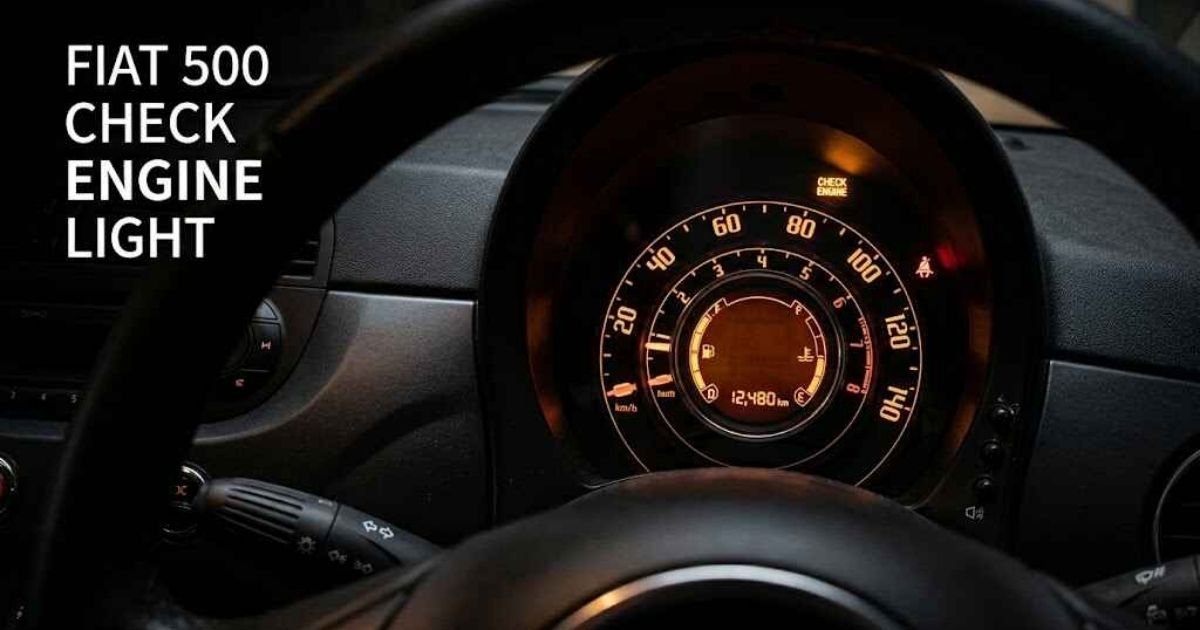
Fiat 500 check engine light on Fiat 500 engine warning light Fiat 500 check engine light flashing Fiat 500 check engine light causes
The Fiat 500 check engine light can mean something as simple as a loose fuel cap or something serious enough to cause power loss and catalytic converter damage. The most important thing is whether the light is steady or flashing and whether the car is running normally.
If the light is steady and your Fiat 500 drives normally, you can usually drive cautiously and arrange a diagnostic scan soon. If the light is flashing, reduce engine load and stop driving as soon as it is safe. Fiat’s owner documentation warns that a flashing malfunction indicator can lead to severe catalytic converter damage and power loss.
Quick Answer
Steady check engine light: Usually safe for a short trip if the car runs normally, but get the fault codes checked soon.
Flashing check engine light: Stop driving as soon as safely possible. An active misfire or serious engine-control problem may be occurring.
Check engine light with shaking or loss of power: Stop and arrange diagnosis rather than continuing to drive.
Light after filling the tank: Check that the fuel cap is properly secured. A loose or missing cap can trigger the MIL on the Fiat 500.
Light comes on briefly when starting: This is normally part of the vehicle’s startup self-check. It should go out after the engine starts.
This guide focuses on petrol Fiat 500 models sold in the US. Exact warning behavior, engines, emissions equipment, and diagnostic codes can vary by model year and engine, so your owner’s manual remains the final reference.
What Does the Fiat 500 Check Engine Light Mean?
The check engine light, officially called the Malfunction Indicator Light (MIL), is connected to the vehicle’s onboard diagnostic system. The system monitors engine and emissions-related functions and stores diagnostic trouble codes when it detects a problem.
The light normally illuminates when you switch the ignition on before starting the engine. It should then go out after the engine starts. Fiat’s 2019 500 owner’s guide explains that the MIL can illuminate because of conditions including a loose or missing gas cap and poor-quality fuel.
The important point is that the check engine light does not tell you which part has failed. It tells you that the vehicle’s computer detected something outside its expected operating range.
That means replacing a spark plug, oxygen sensor, catalytic converter, or another expensive part simply because the check engine light came on is not good diagnosis. The first step is to retrieve the stored diagnostic code and then test the system that generated it.
Steady vs Flashing Fiat 500 Check Engine Light
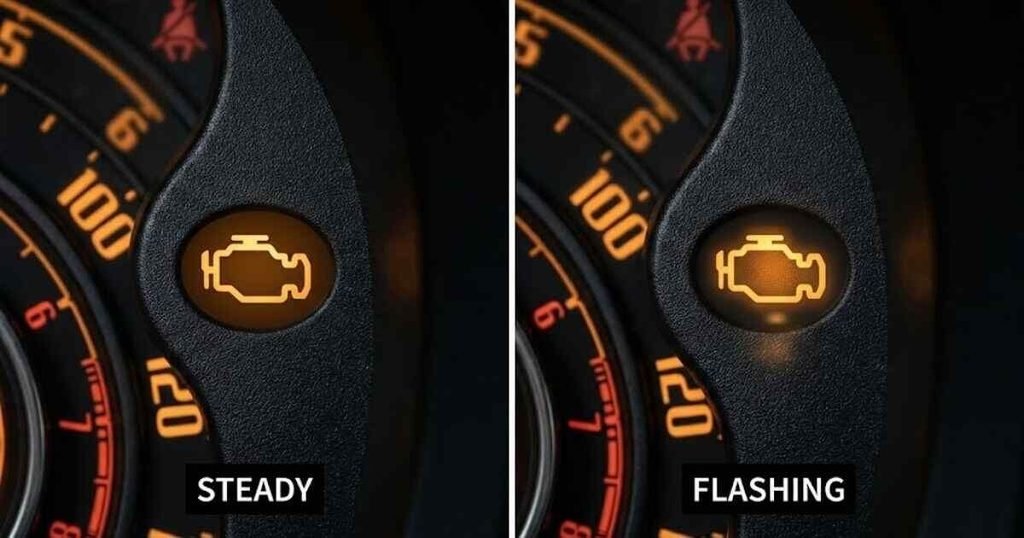
This is the first distinction you should make.
Steady Check Engine Light
A steady light with no major change in how the Fiat 500 drives is generally less urgent than a flashing light.
Fiat’s owner’s documentation says that in many situations the vehicle will continue to drive normally and towing will not be required. However, the vehicle should be serviced if the light remains illuminated through several typical driving cycles.
You can usually drive cautiously to a repair shop if:
- The engine is running smoothly
- There is no major loss of power
- The temperature gauge is normal
- There are no serious additional warning lights
- You do not smell fuel or burning
- The check engine light is steady
Drive-or-stop verdict: Usually driveable for a short distance. Arrange a diagnostic scan soon.
Flashing Check Engine Light
A flashing MIL is different.
Fiat warns that a flashing light can indicate conditions capable of causing immediate power loss or severe catalytic converter damage. Immediate service is required.
A flashing light commonly occurs when the engine is misfiring badly enough for unburned fuel to enter the exhaust.
If your Fiat 500 is also shaking, stumbling, losing power, or making unusual noises, don’t keep driving just because the engine still starts.
Drive-or-stop verdict: Reduce engine load and stop driving as soon as it is safe.
Why Is My Fiat 500 Check Engine Light On?
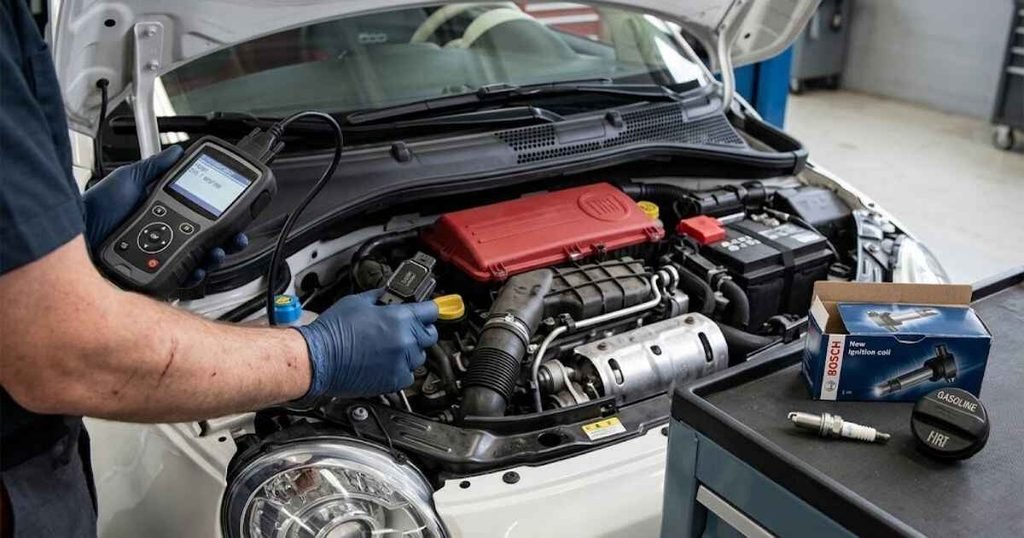
There are many possible causes. Some are inexpensive. Others can become expensive if you continue driving.
1. Loose or Missing Fuel Cap
This is one of the simplest possibilities. Fiat specifically lists a loose or missing fuel cap as a condition that can illuminate the MIL.
If the light appeared shortly after refueling, check the cap first. Make sure it is properly installed and secured.
Don’t expect the light to disappear instantly. The vehicle may need to complete its diagnostic checks over subsequent driving cycles before the warning goes out.
2. Engine Misfire
A misfire happens when one or more cylinders fail to burn the air-fuel mixture correctly.
Common causes include:
- Worn spark plugs
- Failed ignition coils
- Fuel injector problems
- Vacuum or intake leaks
- Fuel delivery problems
- Engine compression problems
A misfire can produce rough idle, shaking, hesitation, poor acceleration and reduced power.
If the check engine light is flashing while the engine is misfiring, stop driving.
3. Oxygen Sensor or Air-Fuel Sensor Problem
The engine computer relies on oxygen and air-fuel sensors to monitor combustion and emissions.
A sensor problem can trigger the check engine light without causing dramatic changes in drivability. You may notice reduced fuel economy or a slight change in engine performance.
Don’t replace the sensor automatically. A wiring problem, exhaust leak, intake issue, or another underlying fault can sometimes produce a similar code.
4. EVAP System Leak
The evaporative emissions system prevents fuel vapors from escaping into the atmosphere.
A loose fuel cap is one possibility, but the EVAP system also contains hoses, valves and other components that can leak or malfunction.
EVAP faults may produce a check engine light while the Fiat continues to drive almost normally.
5. Catalytic Converter Problem
A catalytic converter problem can cause a steady check engine light, reduced performance or poor fuel economy.
A common diagnostic code associated with catalytic converter efficiency is P0420, but the code does not automatically prove that the catalytic converter itself needs replacement.
Before installing an expensive converter, the underlying engine and exhaust system should be diagnosed.
6. Intake or Vacuum Leak
A leak allowing unmetered air into the engine can create an incorrect air-fuel mixture.
Possible symptoms include:
- Rough idle
- Hesitation
- Stalling
- Poor acceleration
- Increased fuel consumption
- Check engine light
A smoke test can sometimes help locate an intake or vacuum leak that isn’t obvious during a visual inspection.
Fiat 500 Check Engine Light but Car Runs Fine
This situation is extremely common.
If your Fiat 500 has a steady check engine light but drives normally, don’t assume that nothing is wrong. Some emissions and sensor faults have little immediate effect on how the engine feels.
A loose fuel cap, EVAP leak or sensor problem can leave the car apparently normal.
The correct approach is to scan the vehicle and find out why the computer stored the fault.
Don’t wait months simply because the car still drives normally. Fiat warns that prolonged driving with the MIL illuminated can affect fuel economy and drivability and may cause vehicle-control-system damage.
Fiat 500 Check Engine Light and Shaking
If your Fiat 500 is shaking while the check engine light is flashing, treat it as an urgent situation.
The most likely category is an engine misfire, although other faults can also produce rough running.
The combination of:
Flashing check engine light + shaking + poor acceleration
is much more concerning than a steady light with completely normal driving.
Reduce engine load, avoid hard acceleration and get the vehicle somewhere safe. Continuing to drive a severe misfire can damage the catalytic converter.
Common Fiat 500 OBD-II Codes
An OBD-II scan gives you a starting point for diagnosis.
Some codes you may encounter include:
| Code | General meaning | Possible area |
|---|---|---|
| P0300 | Random/multiple cylinder misfire | Ignition, fuel or engine |
| P0301 | Cylinder 1 misfire | Ignition, injector or compression |
| P0302 | Cylinder 2 misfire | Ignition, injector or compression |
| P0303 | Cylinder 3 misfire | Ignition, injector or compression |
| P0304 | Cylinder 4 misfire | Ignition, injector or compression |
| P0171 | System too lean | Intake, fuel or sensor issue |
| P0420 | Catalyst efficiency below threshold | Catalytic converter or related system |
| P0455 | Large EVAP leak | EVAP system |
| P0456 | Small EVAP leak | EVAP system |
These codes should be treated as diagnostic clues, not automatic parts-replacement instructions.
For example, P0301 tells you that the system detected a misfire associated with cylinder 1. It doesn’t automatically mean the ignition coil is bad.
What Should You Check First?
If the light is steady and the Fiat 500 is running normally, start with the simple checks.
Step 1: Check the Fuel Cap
If the light appeared after refueling, make sure the fuel cap is properly installed.
Step 2: Notice How the Engine Runs
Ask yourself:
- Is the engine shaking?
- Is acceleration normal?
- Is the idle smooth?
- Has fuel economy suddenly dropped?
- Is there an unusual smell?
- Has the vehicle entered limp mode?
These symptoms help determine urgency.
Step 3: Scan the OBD-II System
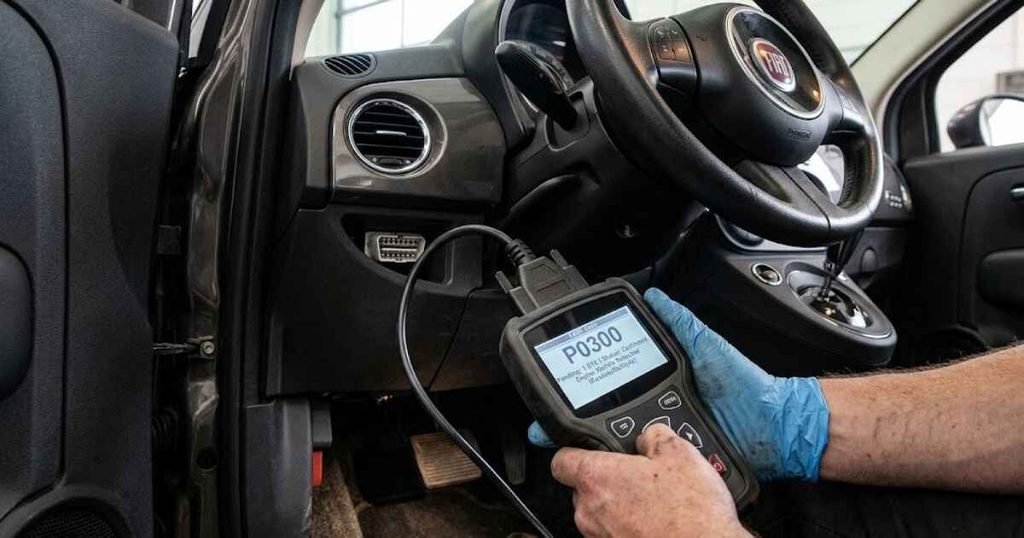
Read the stored codes before replacing parts.
A scanner can identify the system that triggered the MIL and give you a much better starting point for diagnosis.
Step 4: Don’t Clear the Code Immediately
Clearing the code removes useful diagnostic information and resets emissions monitors.
If you’re taking the Fiat to a technician, record the codes first.
This is particularly important if your state requires emissions testing. Fiat’s owner’s documentation notes that the OBD-II system is also involved in emissions inspection and readiness checks.
Can You Reset the Fiat 500 Check Engine Light?
You can clear a diagnostic code with appropriate diagnostic equipment, but resetting the light is not the same as fixing the problem.
If the underlying fault remains, the light can return.
It is better to:
- Read the codes.
- Diagnose the cause.
- Repair the underlying problem.
- Clear the code if appropriate.
- Drive through the required monitoring conditions.
- Confirm the light stays off and the system becomes ready.
Don’t disconnect the battery simply to make the warning disappear. You can erase useful diagnostic information and reset readiness monitors without repairing the actual fault.
When Should You Stop Driving?
Stop driving and arrange professional diagnosis if the Fiat 500 has a flashing check engine light, especially when combined with:
- Severe shaking
- Major loss of power
- Loud engine noises
- Overheating
- Smoke
- Burning smell
- Fuel smell
- Another serious warning light
- Limp mode
A steady check engine light with normal operation is generally less urgent, but it still deserves a scan and diagnosis.
If you have concerns about a potential safety defect or want to check whether your particular Fiat has an open recall, use the official NHTSA recall lookup. NHTSA allows owners to check recalls using the vehicle identification number, and recall repairs are generally performed by the manufacturer at no charge when an applicable safety recall is open.
Fiat 500 Check Engine Light After Refueling
If the light appeared shortly after filling the tank, don’t panic.
Start with the fuel cap because Fiat specifically identifies a loose or missing cap as one possible cause of the MIL.
If the cap is secure and the light remains on after normal driving, scan the vehicle.
If the light is flashing or the engine is running badly, the fuel cap should not be your only concern. Stop driving and have the vehicle diagnosed.
Fiat 500 Check Engine Light After an Oil Change
An oil change doesn’t normally cause the check engine light by itself, but service-related problems can occur.
Check whether:
- The oil level is correct
- The correct oil was used
- The oil filler cap is installed
- Any electrical connector was disturbed
- The engine is running normally
- Another warning light is illuminated
If you also see the red oil pressure warning, treat that separately. Do not continue driving simply because the check engine light is steady. Your Fiat 500 oil warning light guide explains the difference between an oil pressure warning and a routine service issue.
Fiat 500 Check Engine Light: Drive-or-Stop Guide
| Situation | Drive? | What to do |
|---|---|---|
| Steady light, car drives normally | Usually yes | Scan soon |
| Steady light + slight hesitation | Cautiously | Diagnose promptly |
| Flashing light | No | Stop safely |
| Flashing + shaking | No | Arrange assistance |
| Light + major power loss | No | Stop and diagnose |
| Light + overheating | No | Stop immediately |
| Light after refueling, runs normally | Usually yes | Check fuel cap and scan |
| Light with red oil-pressure warning | No | Stop engine |
| Light with smoke or burning smell | No | Stop safely |
Frequently Asked Questions
Is the Fiat 500 check engine light serious?
It depends on whether it is steady or flashing and how the car is behaving. A steady light with normal driving is usually less urgent. A flashing light can indicate a serious fault capable of causing power loss and catalytic converter damage.
Can I drive my Fiat 500 with the check engine light on?
If the light is steady and the car is running normally, a short trip to a repair facility is generally reasonable. If it is flashing or the engine is shaking, losing power or overheating, stop driving.
Why is my Fiat 500 check engine light on but the car runs fine?
Possible causes include an EVAP leak, loose fuel cap, sensor fault or another emissions-related problem. The vehicle may feel completely normal even though the computer has detected a fault.
What does a flashing check engine light mean?
A flashing MIL can indicate a condition that may cause severe catalytic converter damage or power loss. Fiat’s documentation calls for immediate service when the light flashes.
Will the Fiat 500 check engine light turn off by itself?
It can if the condition that triggered it is no longer detected, but you should not rely on that. A diagnostic scan is the better way to determine what happened.
Can a bad gas cap cause a Fiat 500 check engine light?
Yes. Fiat specifically lists a loose or missing fuel cap as one possible reason for the MIL to illuminate.
The Bottom Line
The Fiat 500 check engine light isn’t automatically a reason to panic, but you should never ignore the difference between a steady and flashing warning.
A steady light with normal driving usually gives you enough time to arrange a diagnostic scan without immediately towing the car. A flashing light, especially with shaking, misfiring or power loss, is a different situation. Reduce engine load and stop driving as soon as it is safe.
Start with the simple things, including the fuel cap if the warning appeared after refueling. Then scan the OBD-II system and diagnose the actual cause rather than replacing parts based on the warning light alone.
If the Fiat 500 also has an oil warning, use the Fiat 500 Oil Warning Light guide because an oil pressure warning requires a different response.
For the complete dashboard reference, see the Fiat 500 Warning Lights guide.
And if you’re in the US, check the official NHTSA recall database by VIN before paying for a repair when you suspect a safety-related problem.