

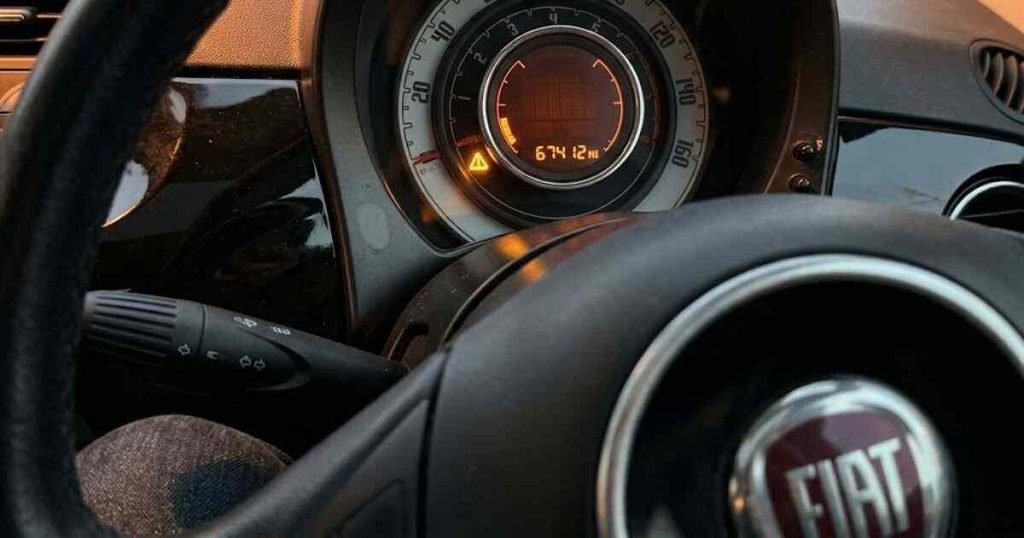
So the amber triangle just appeared on your Fiat 500’s dashboard. You’re probably wondering what has gone wrong and whether it is safe to keep driving.
Here’s the important part: the Fiat 500 amber triangle warning light is a general failure indicator, not a warning for one specific component. Depending on the model year, trim, engine, and equipment, it can appear when the car detects a fault in different systems.
The dashboard message that appears with the triangle is often the most useful clue. If there is no message, you can still narrow down the problem by checking the other warning lights, noticing which features have stopped working, and reading the stored fault codes.
Quick Answer
Amber triangle only, car drives normally: Drive cautiously to a safe location and arrange a diagnostic scan.
Amber triangle with a dashboard message: Read and photograph the message before switching off. It can identify the affected system or condition.
Amber triangle alongside a red warning: Treat the red warning as the priority and stop safely when appropriate.
Triangle disappears after a restart: Do not assume the problem is fixed. An intermittent fault or stored fault code may still be present.
This guide covers petrol Fiat 500 models across multiple generations. It does not cover Fiat 500e high-voltage battery and electrical-system warnings, which use different systems and require model-specific documentation.
Why the Amber Triangle Appears on a Fiat 500
The Fiat 500 amber triangle is used as a general failure or fault indication when the vehicle detects a condition that may not have its own dedicated warning lamp. The exact meaning can vary between model years and equipment levels.
That means two Fiat 500 owners can see the same amber triangle while dealing with completely different issues.
Depending on the vehicle, possible causes or accompanying conditions can include:
- Exterior lighting faults
- Start and Stop system unavailable
- Parking sensor or parking assistance faults
- Electronic stability or traction-control-related faults
- Battery or charging-system problems
- Engine-management or other electronic control-system faults
- Other vehicle-system faults identified through a dashboard message
The triangle itself is therefore not the diagnosis. It tells you that the vehicle has detected something that needs attention. The dashboard message, other warning lights, and diagnostic codes provide the information needed to identify the underlying issue.
If a message appears, read it before clearing anything.
The Amber Triangle With No Message: What to Check First
This is one of the most frustrating situations: the triangle is illuminated, but the instrument display gives you little or no additional information.
Don’t start replacing parts based on the triangle alone.
Work through these checks in order:
- Restart the car once and note whether the triangle clears or remains illuminated.
- Walk around the vehicle and check the exterior lights, including headlights, brake lights, indicators, tail lights, and number-plate lights.
- Check whether features such as Start and Stop, parking sensors, or traction-control functions are unavailable.
- Pay attention to how the car drives, brakes, and steers.
- Check whether another warning light is illuminated at the same time.
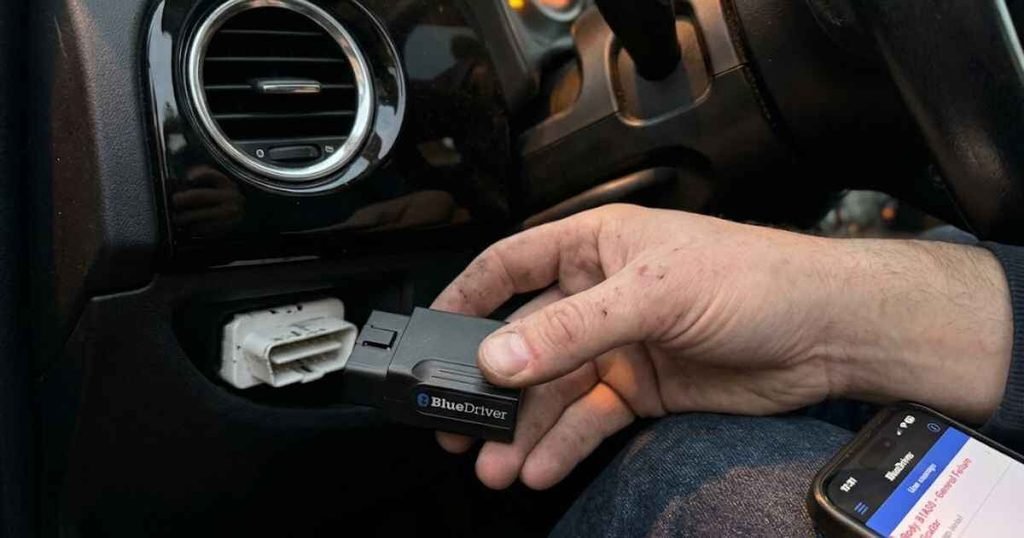
- Use a suitable diagnostic scanner to read stored fault codes before clearing them.
A basic OBD-II scanner can be useful for engine and emissions faults, but it may not communicate with every control module on a Fiat 500. If the triangle remains illuminated and a basic scanner finds nothing, a Fiat-capable diagnostic tool may be needed.
Older Fiat 500 versions can also provide less information on the instrument display than newer versions. In those vehicles, diagnostic scanning can be particularly useful when there is no accompanying message.
Common Amber Triangle Combinations and What They Mean
Amber Triangle and Start and Stop Unavailable
Start and Stop can become unavailable when the vehicle determines that operating conditions are not suitable or when another system condition affects its operation.
A low or weak battery, charging-system problem, engine temperature, climate-control demands, or another vehicle fault can prevent the system from operating.
Don’t replace the battery solely because Start and Stop has stopped working. Check the battery and charging system and scan for stored fault codes first.
If Start and Stop repeatedly remains unavailable over several journeys, especially when accompanied by the amber triangle, it is worth having the vehicle diagnosed.
Amber Triangle and Check Engine Light
The check engine light provides more specific information than the general triangle because it indicates that the engine-management or emissions system has stored a diagnostic fault.
Steady check engine light: If the car drives normally and there are no serious symptoms, arrange a diagnostic scan soon.
Flashing check engine light: Treat this as urgent. A flashing malfunction indicator can indicate an active misfire, and continued driving can cause further damage, including damage to the catalytic converter.
The amber triangle in this situation is secondary to the specific engine warning. Read the diagnostic codes before clearing them.
Amber Triangle and ABS or ESC Warning
If the amber triangle appears together with an ABS or ESC warning, a fault has been detected in one or more chassis-control systems.
The vehicle may still have normal basic braking, but ABS or electronic stability-control assistance may be unavailable or limited.
If the brake pedal feels completely normal and there are no red brake warnings, drive cautiously only as far as necessary to reach a safe location or repair facility.
Stop driving and seek assistance if:
- The brake pedal feels soft or spongy
- The pedal travels unusually far
- The vehicle pulls significantly while braking
- A red brake warning appears
- Braking performance feels different from normal
A diagnostic scan can help identify whether the problem is related to a wheel-speed sensor, wiring, control module, or another component.
Amber Triangle and Red Oil or Temperature Warning
If an amber triangle appears together with a red oil-pressure or engine-temperature warning, the red warning takes priority.
Pull over safely and follow the instructions for the red warning.
A red oil-pressure warning can indicate inadequate engine lubrication. Continuing to drive can cause severe engine damage.
A red engine-temperature warning indicates that the engine may be overheating. Stop safely and allow the vehicle to cool before attempting further checks.
The amber triangle does not make either red warning less serious.
Can You Drive With the Amber Triangle On?
Usually, a short, cautious drive may be reasonable if the amber triangle is the only warning, the car feels completely normal, and there are no serious dashboard messages.
However, the correct response depends on what caused the warning.
Do not continue driving if you notice:
- A red oil-pressure, temperature, or serious brake warning
- A soft or unusually long brake pedal
- Significant loss of engine power
- Severe engine shaking or a flashing check engine light
- Smoke or a strong burning smell
- Unusual mechanical noises
- Major steering problems
- Multiple serious warning lights appearing together
If the car is behaving normally and the triangle is the only warning, arrange a diagnostic check rather than continuing to drive indefinitely with the warning illuminated.
Amber Triangle vs Red Warning: Know the Difference
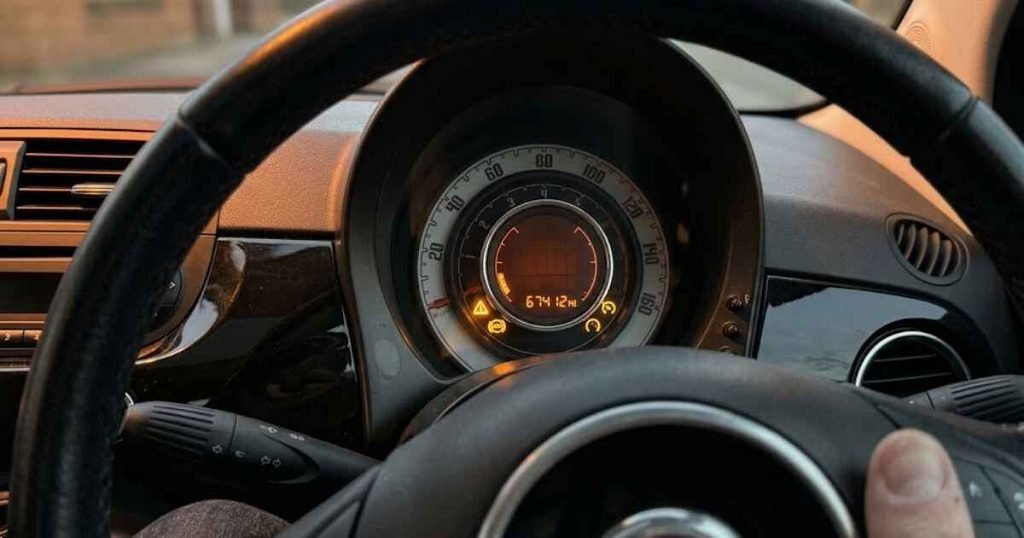
An amber triangle is generally an attention or fault indicator. It tells you that the vehicle has detected a condition that needs investigation.
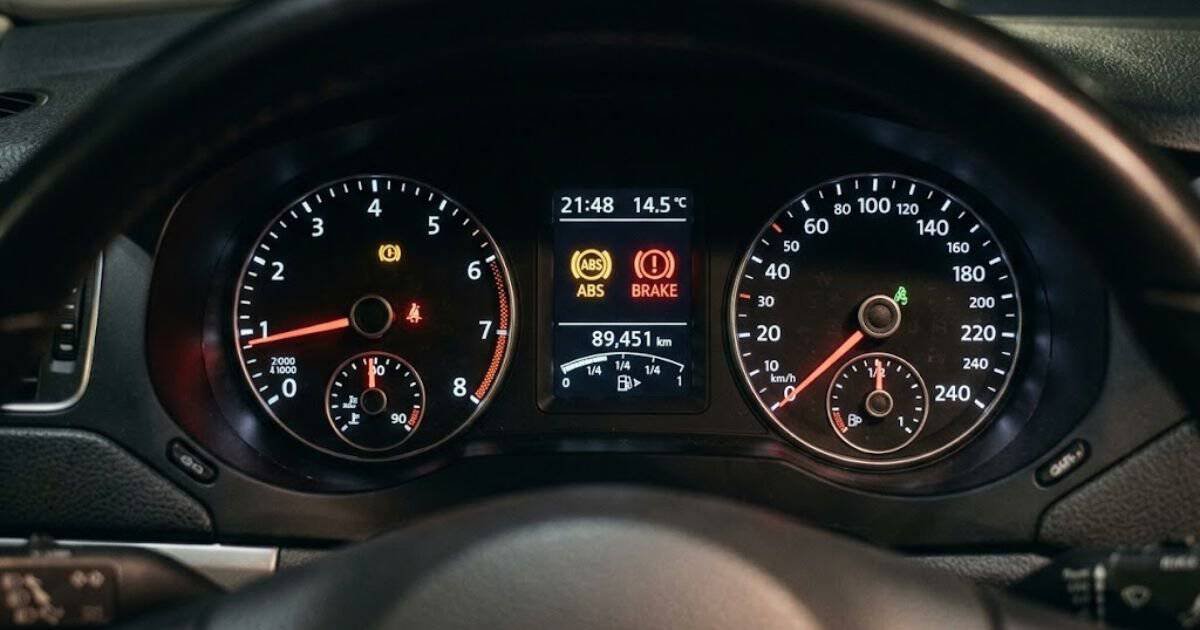
A red warning light normally indicates a more urgent condition, particularly when it relates to oil pressure, engine temperature, or the braking system.
If an amber triangle and a red warning appear together, follow the instructions for the red warning first.
The triangle should not be interpreted in isolation. The exact dashboard message, additional warning lights, and the way the car behaves are what determine the appropriate response.
Should You Reset the Amber Triangle?
No—not before finding out why it appeared.
Clearing the warning or disconnecting the battery can remove useful diagnostic information. If the underlying problem is still present, the warning may simply return.
A better sequence is:
- Read the dashboard message.
- Photograph or note any warning message and additional lights.
- Scan for stored diagnostic codes.
- Identify and repair the underlying fault.
- Clear the codes after the problem has been addressed.
- Drive the vehicle and confirm that the warning does not return.
If the triangle disappears after restarting the car, that does not necessarily mean the problem has been permanently resolved. Intermittent faults can temporarily stop triggering the warning.
Amber Triangle Quick Decision Table
| What You See | Possible Situation | What to Do |
|---|---|---|
| Triangle only, car normal | General fault, system unknown | Check lights and scan for codes |
| Triangle with dashboard message | System or condition identified | Follow the message and investigate |
| Triangle with steady check engine | Engine-management or emissions fault | Arrange a diagnostic scan soon |
| Triangle with flashing check engine | Possible active misfire | Stop driving when safe |
| Triangle with Start and Stop unavailable | Battery, charging, operating condition, or another fault | Check battery/charging system and scan codes |
| Triangle with ABS or ESC warning | Chassis-control system fault | Drive cautiously only if braking feels normal; arrange diagnosis |
| Triangle with red oil warning | Possible lubrication problem | Stop safely and switch the engine off |
| Triangle with overheating warning | Possible engine-temperature problem | Stop safely and allow the engine to cool |
| Triangle with abnormal braking | Possible brake-system problem | Stop driving and seek assistance |
These are general guidelines. Your exact Fiat 500 model year, engine, trim, and equipment can change the meaning of individual indicators.
How to Find the Exact Cause for Your Specific Fiat 500

Before scanning the car or contacting a repair shop, record as much information as possible:
- Model year and engine
- Petrol or diesel
- Manual or automatic transmission
- Exact dashboard message
- Other warning lights illuminated
- Whether the triangle is steady or intermittent
- Which vehicle features have stopped working
- Any change in braking, steering, acceleration, engine noise, or smell
This information can significantly narrow down the possible causes.
For the exact symbol definitions and model-specific instructions, use the owner’s documentation for your vehicle. Fiat’s official eLUM documentation provides owner information for Fiat vehicles and should take priority over a generic warning-light guide.
Frequently Asked Questions
What does the amber triangle mean on a Fiat 500?
It is a general failure or attention indicator rather than a diagnosis of one specific component. Check the dashboard message and any other warning lights, then scan for diagnostic codes if the warning remains.
Is it safe to drive a Fiat 500 with an amber triangle warning light?
Usually, if the triangle is the only warning and the car drives, brakes, and steers normally, you can drive cautiously to a safe location or repair facility. Stop if a red warning appears or the vehicle behaves abnormally.
Why does my Fiat 500 amber triangle come on with Start and Stop unavailable?
Start and Stop can be disabled when operating conditions are unsuitable or when the vehicle detects another system condition. A weak battery or charging issue is one possibility, but the warning should be diagnosed rather than assuming the battery is the cause.
How do I fix the amber triangle warning on my Fiat 500?
You fix the underlying condition rather than the triangle itself. Read the dashboard message, scan for diagnostic codes, identify the affected system, repair the problem, and then clear the warning if appropriate.
Why does the Fiat 500 amber triangle disappear after I restart the car?
An intermittent condition can stop triggering the warning after a restart. That does not necessarily mean the underlying issue has been fixed. If the warning returns, scan the vehicle for stored diagnostic information.
The Bottom Line
The Fiat 500 amber triangle warning light is a general fault indicator, not a diagnosis of one particular component.
If the triangle appears, start with the dashboard message. If there is no useful message, check the exterior lights, look for other warning indicators, pay attention to how the car drives, and scan for stored diagnostic codes before replacing parts.
If the triangle is accompanied by a red oil-pressure, temperature, or serious brake warning, deal with the red warning first.
And if the triangle disappears after restarting, don’t automatically assume the problem is gone. An intermittent fault can return later.
For the complete breakdown of Fiat 500 dashboard symbols, colors, and urgency levels, see the Fiat 500 Warning Lights: What Every Dashboard Symbol Is Telling You guide. This page focuses specifically on the amber triangle and how to diagnose it.

2 thoughts on “Fiat 500 Amber Triangle Warning Light: What It Means and What to Check”